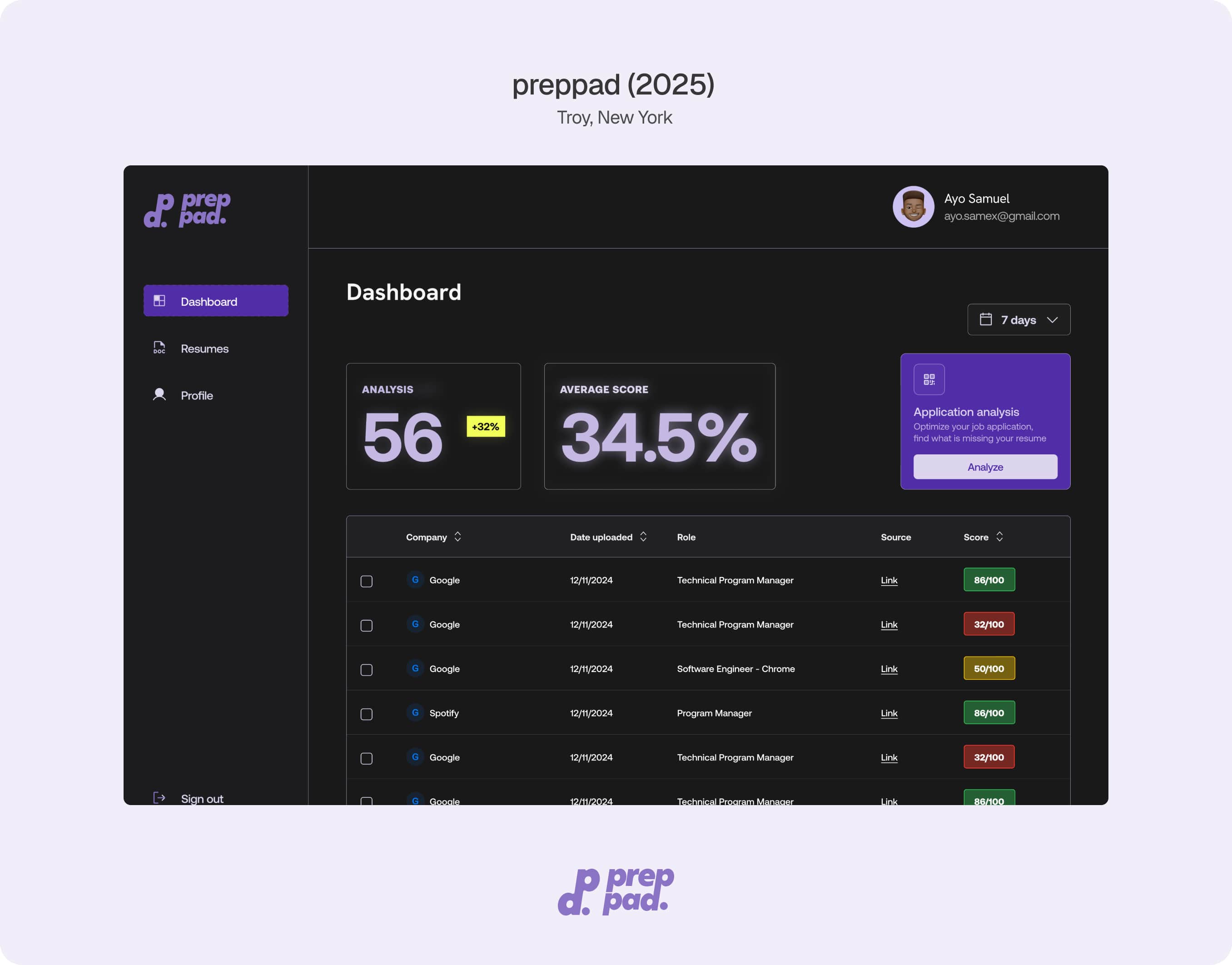
prepPad: Designing an AI-Driven Bridge to Student Employment.

prepPad: Designing an AI-Driven Bridge to Student Employment.

Empowering students to bypass the ATS through AI-driven skill-gap analysis, keyword optimization, and affordable application insights

Problem

Students face high rejection rates as 75% of resumes are filtered out by automated systems before reaching recruiters. Manual tailoring is inefficient and expensive, creating barriers to essential job-matching tools.

Solution

This product leverages AI and NER to automate resume parsing and job comparison for instant, data-driven insights. Users receive match ratings and keyword suggestions to optimize resumes for ATS filters at no cost.

My Role

Product Manager & Lead Designer

Timeline

5 months (Jan 2025 - May 2025)

As the Product Manager and UX Designer for prepPad, I led our team to solve a systemic barrier: the 'black hole' of job applications. In an era where algorithms often outpace human judgment, college students and early-stage professionals find themselves trapped in a cycle of high-volume applications with low-percentage returns. This case study details our journey from identifying a gap in the market to deploying an AI-powered career tool for students.

The Discovery Phase: Defining the Problem

Understanding modern job search challenges.
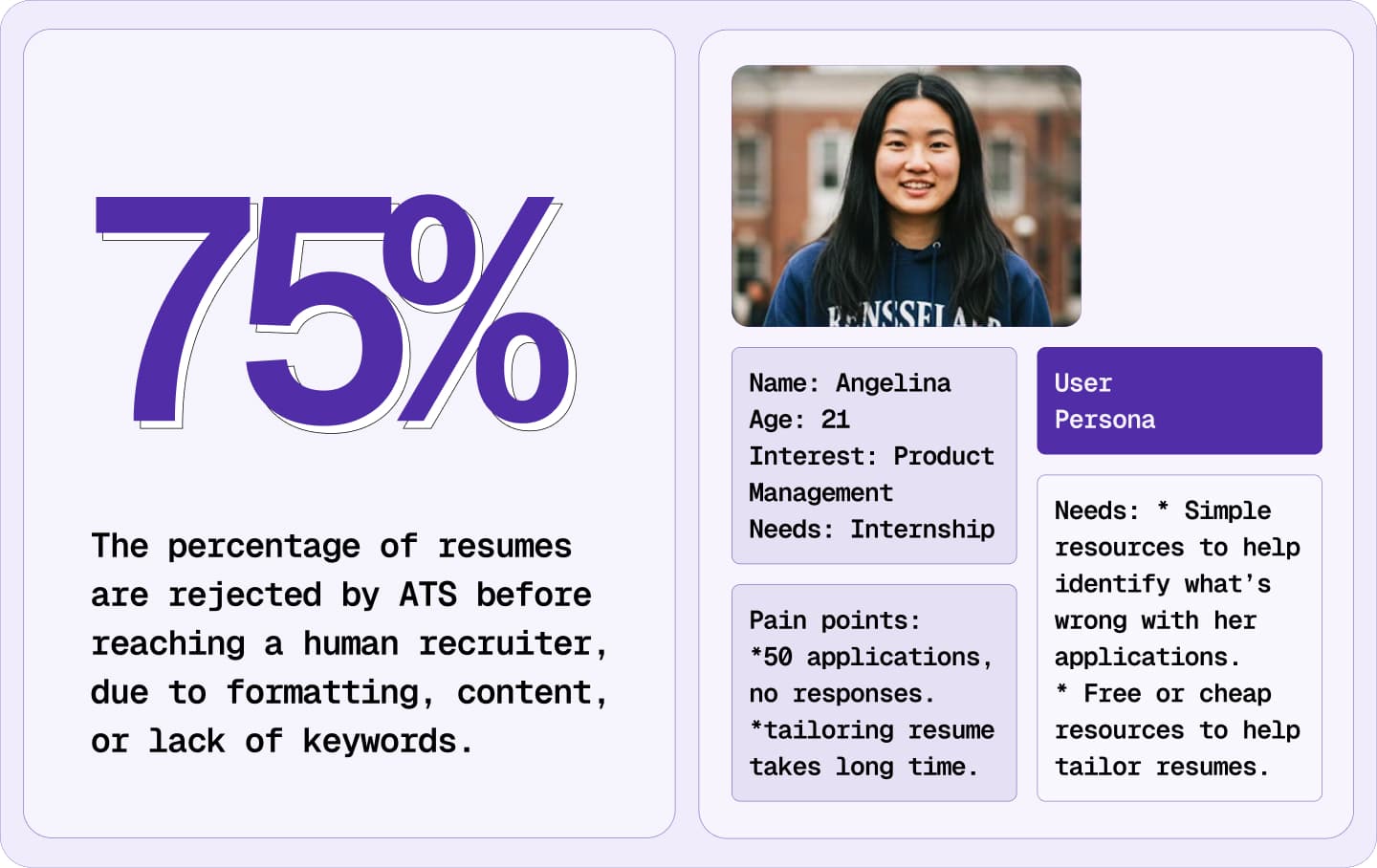
The journey began by humanizing the data. I developed the persona of Angelina, a 21-year-old student who had applied to over 50 internships without a single human response. Her experience highlighted two primary industry hurdles: • The ATS Gatekeeper: Research indicates that approximately 75% of resumes are rejected by Applicant Tracking Systems (ATS) due to formatting errors or a lack of specific keywords before they ever reach a recruiter. • The Financial Barrier: Existing premium platforms like LinkedIn Learning or Simplify Premium charge roughly $30 per month; a prohibitive cost for a student already struggling to enter the workforce. I realized that prepPad didn't just need to be a technical tool; it needed to be a simple, intuitive resource available for free or at a very low cost to solve the inefficiency of manual resume tailoring.
User research findings and persona development

Key user insights and persona mapping from our research phase

Strategic Vision & The 'Three-Layer' Solution

Architecting a scalable ecosystem to deliver high-performance AI analysis.
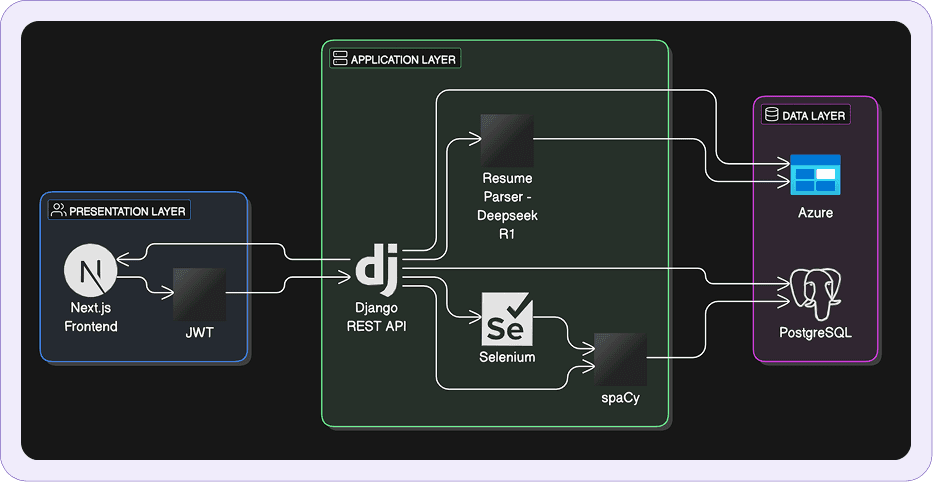
To address these needs, I orchestrated a high-performance Three-Layer Architecture designed for speed and precision: • Presentation Layer (UX): I designed a clean, responsive interface using Next.js and Tailwind CSS. It was vital that the UI was inclusive, so we adhered to AAA accessibility standards and implemented a dark mode specifically for students who often job-hunt during late hours. • Application Layer (Logic): Our backend, powered by the Django REST Framework, handles the 'heavy lifting'. We integrated DeepSeek-V3 and spaCy for high-fidelity Natural Language Processing (NLP) to extract education, skills, and experience from uploaded documents. • Data Layer (Storage): We utilized PostgreSQL hosted on Supabase. By saving parsed resume data and job results as JSON within the database, we eliminated the need for complex external file storage services.
User research findings and persona development

3-layer Architecture enabling speed and precision

Process: Lean Agility in Action

Leveraging Lean Kanban and iterative sprints to maximize team velocity.
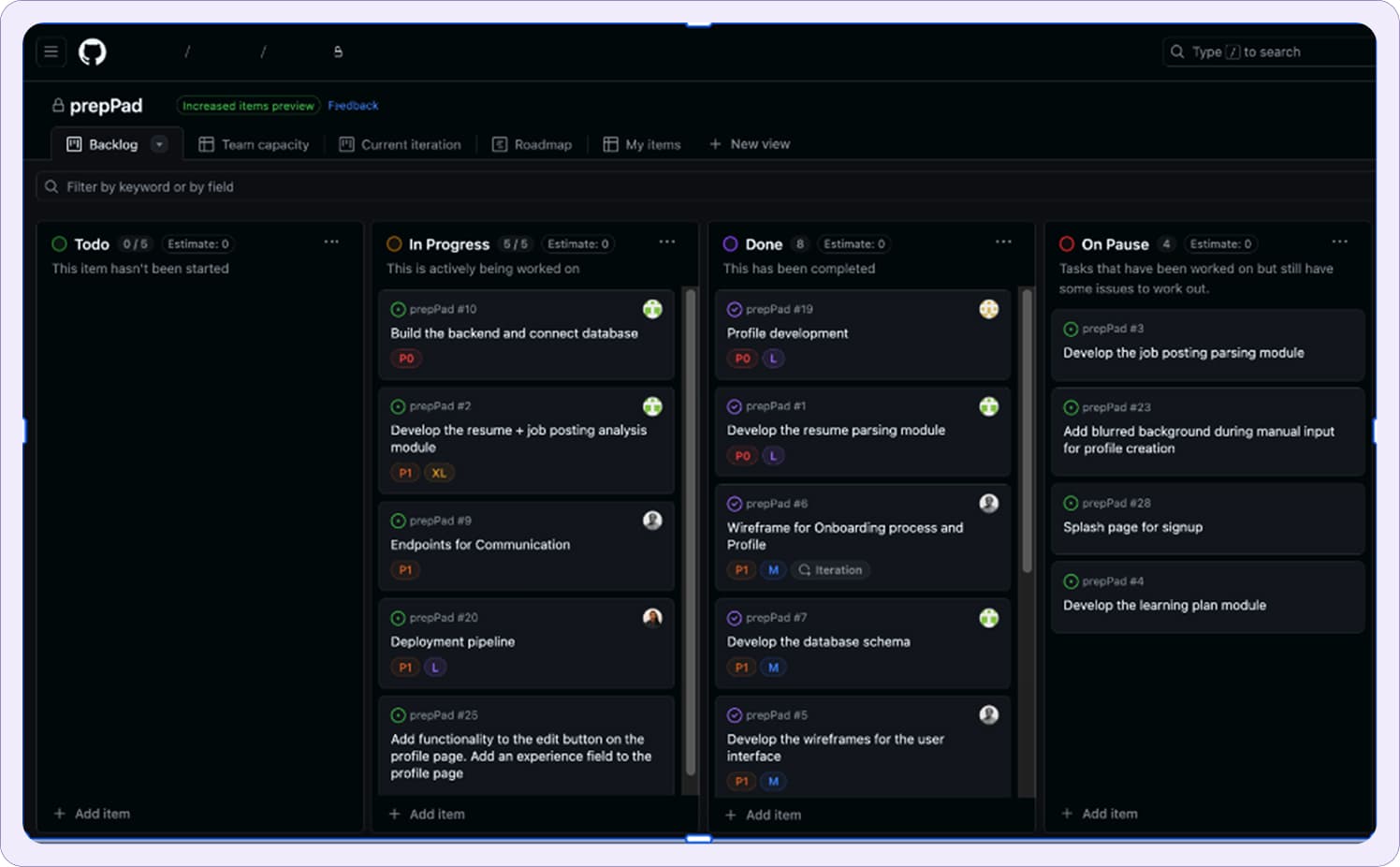
Managing a small team of four required a disciplined, iterative approach. I implemented Lean principles with a Kanban board to maximize our collective effort and maintain a fast feedback loop. • Prioritization: We utilized GitHub Projects to rank tasks from P0 (Critical) to P1 (Secondary). For instance, while I initially planned for complex UI animations, we paused them to focus on the Matching Engine, which was our core value proposition. • Validation through 'Seeded' Development: We didn't build in a vacuum. We first implemented seeded test users to verify backend logic and database relationships before finalizing the complete registration system. • The Scraping Pivot: Our initial parsing struggled with modern, dynamically loaded job boards. I led the pivot to incorporate Selenium automation, ensuring we could bypass static limitations and accurately extract job information from complex platforms.
User research findings and persona development

3-layer Architecture enabling speed and precision

Overcoming Technical Debt & Blockers

Eliminating cross-platform bottlenecks and stabilizing scraping logic.

The process of building this, just like many, involved several frictions. As the PM, I facilitated solutions for these critical bottlenecks: • Platform Incompatibilities: The team faced 'dependency incompatibility' where code worked on Intel-based systems but failed on Apple Silicon (M1/M2). We modified our Dockerfile and deployment pipeline, incorporating specific multi-arch build commands and platform-specific environment checks. This ensured that the GitHub Actions and Docker workflows functioned seamlessly across all team configurations. • Parsing Accuracy: Standard NLP models often struggle with messy document layouts. We implemented advanced text-cleaning algorithms to normalize raw text before it reached our AI models, ensuring consistent results regardless of the original resume's design.

Iteration: Privacy-First Onboarding

Iterative development based on user feedback.
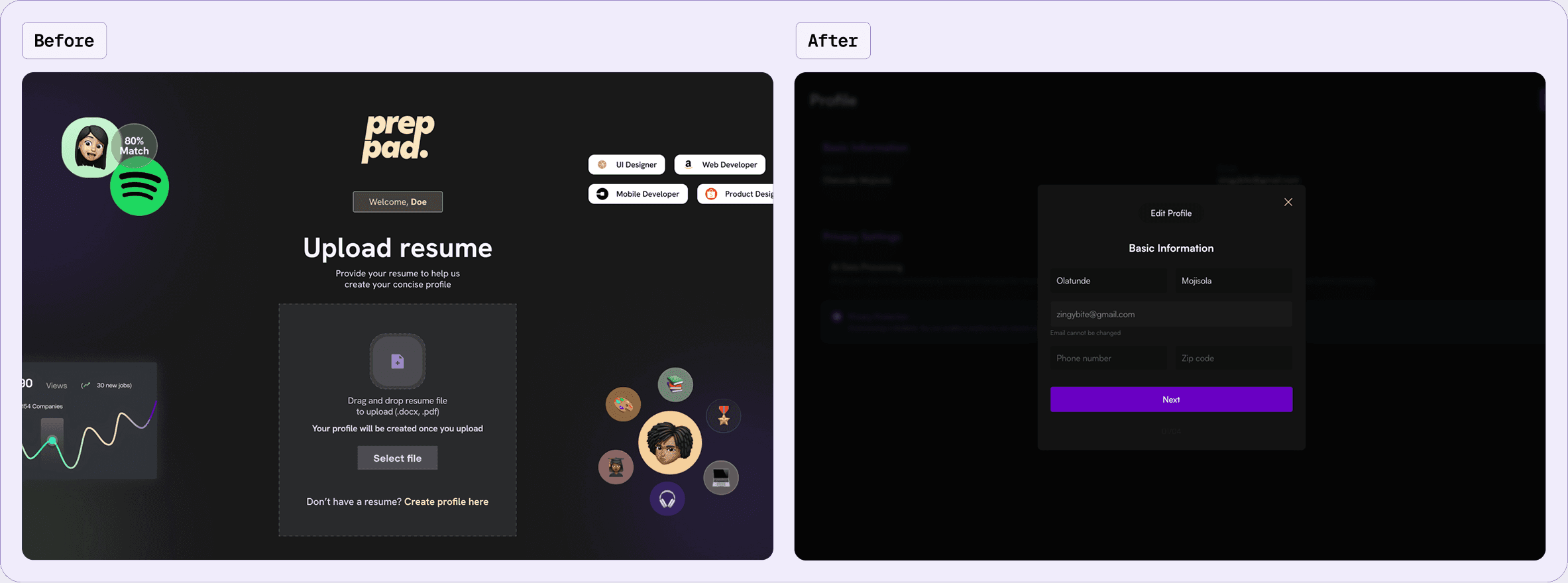
We prioritized user security by redesigning the onboarding workflow to prevent Personally Identifiable Information (PII) from reaching the AI model. We replaced the automated 'Resume-to-Profile' setup with a secure email and password registration, ensuring no sensitive data is processed without explicit consent. The IPP Workflow To enforce data sovereignty, we implemented an Identity Privacy Protection (IPP) process. This system gives users granular control, allowing them to redact personal identifiers, such as contact details and specific locations, before the resume is passed to the DeepSeek-V3 model for analysis. This ensures the matching engine evaluates professional qualifications without ever 'seeing' the user’s private identity.
AI-powered features demonstration

Initial onboarding flow vs. Iterated onboarding flow

Final Results & Future Roadmap

Delivering immediate ATS optimization while planning enhancements.
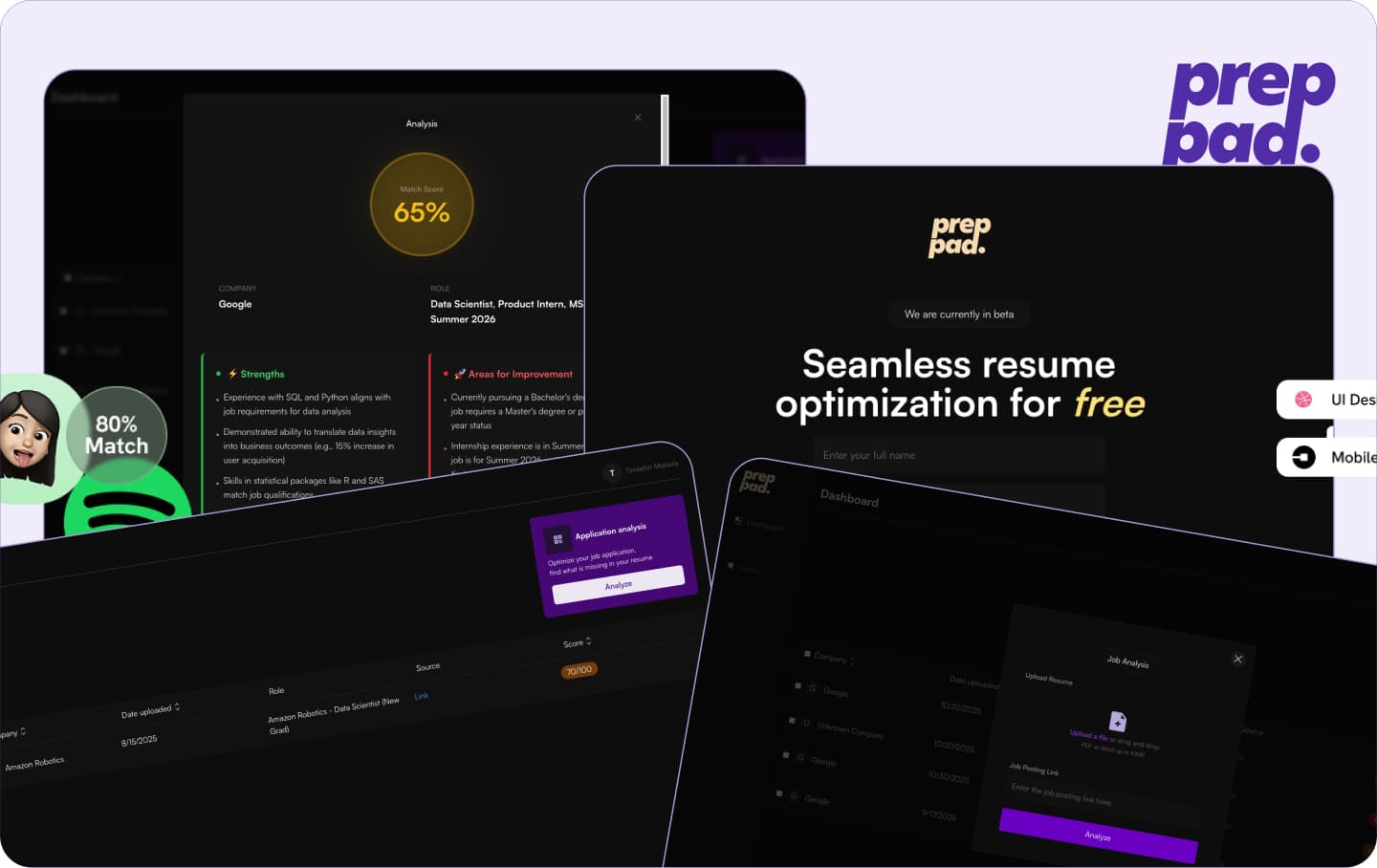
AI-powered features demonstration

Initial onboarding flow vs. Iterated onboarding flow

The MVP of prepPad successfully delivers professional-grade insights at zero cost to the student. Our evaluation shows high accuracy in three key areas: • Skills Gap Identification: Comparing extracted resume data against job qualifications to highlight exactly what technical abilities a candidate is missing. • ATS Keyword Identification: Pinpointing critical industry terms found in job postings that are absent from the user's resume to improve visibility in automated filters. • Actionable Feedback: Providing quantitative match scores and qualitative 'tips for improvement' to help users strategically modify their materials. What's next? I am currently planning a Learning Plan Generator to suggest specific free resources for identified gaps and an Application Timeline Visualization to help students track their journey from 'Applied' to 'Hired'.

Try prepPad yourself

Visit Live App

Looking to collaborate,
hire or just chat?

olatunde.moj@gmail.com